

The PWM waveform output by the frequency converter contains a large number of high-frequency harmonics, which can cause partial discharge in the windings and accelerate insulation aging.
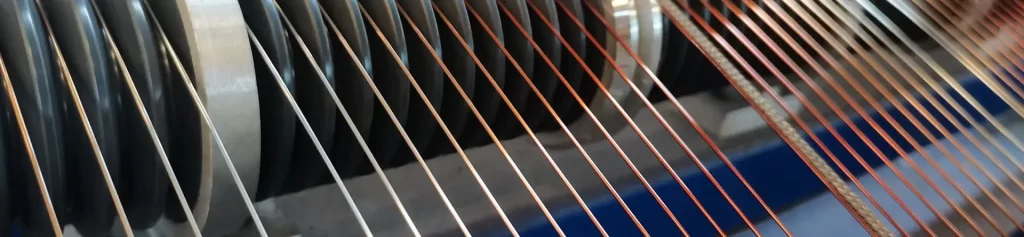
Corona-resistant enameled copper wire effectively suppresses partial discharge through nano-inorganic filler technology, making it an ideal choice for variable frequency motors.
Insulation Challenges of Variable Frequency Motors Impact of PWM Waveform on Insulation The PWM waveform output by the frequency converter differs from the traditional sine wave.
Its high-frequency harmonic components can cause the following problems in the motor windings: Voltage overshoot.
When the cable length is long, voltage wave reflection can generate a peak value of 2-3 times the DC bus voltage.
Uneven inter-turn voltage.
The coil turns near the input end bear the highest voltage stress.
Skin effect.
High-frequency harmonics increase eddy current losses and accelerate insulation thermal aging. Hazards of Partial Discharge Partial discharge is the main cause of insulation aging.
The ultraviolet radiation, ozone, and high-energy particles generated by the discharge bombard the insulating material, causing molecular chain breakage, insulation embrittlement, and performance degradation.
The partial discharge frequency of a variable frequency motor under PWM voltage can reach thousands to tens of thousands of times per second, far exceeding the power frequency conditions.
Technical Principles of Corona-Resistant Enameled Wire Mechanism of Action The insulation layer of corona-resistant enameled wire suppresses partial discharge through the following mechanisms: Trapping effect.
Inorganic fillers form charge traps, capturing free charges and preventing the discharge from continuing.
Tortuous effect.
The discharge path is forced to bypass inorganic particles, significantly lengthening it and reducing the destructive efficiency.
Energy dissipation.
Inorganic fillers absorb discharge energy, reducing bombardment damage to the organic matrix. Types of Nanofillers Commonly used nano-inorganic fillers include: Alumina (Al₂O₃).
Improves the discharge resistance and heat dissipation performance of the insulation layer.
Silica (SiO₂).
Forms a dense structure, improving hardness and wear resistance.
Boron nitride (BN).
It has excellent thermal conductivity, reducing temperature rise during high-frequency operation. Product Classification and Performance Comparison According to the insulation system, corona-resistant enameled copper wire is mainly divided into: CR-PEI (corona-resistant polyester imide): heat resistant to 180°C, the most widely used.
CR-PI (corona-resistant polyimide): heat resistant above 220°C, suitable for high-end applications.
CR-PE (corona-resistant polyester): heat resistant to 155°C, economical price.
The partial discharge initiation voltage (PDIV) of corona-resistant enameled wire can reach 800-1200V or more, far exceeding the 400-600V of ordinary enameled wire.

Typical Application Areas High-Voltage Variable Frequency Motors Variable frequency motors with voltage levels above 660V are the main application area for corona-resistant enameled wire.
Ordinary enameled wire is prone to insulation failure within 1-3 years, while corona-resistant products can operate stably for 15-20 years.
Typical applications include variable frequency drive systems for mine hoists, large water pumps, and petrochemical compressors. Special Variable Frequency Motors Variable frequency crane motors need to withstand frequent forward and reverse rotations and starting and braking shocks; corona-resistant enameled wire ensures reliable operation under harsh conditions.
Rail transit auxiliary motors need to meet both reliability and flame retardancy requirements; corona-resistant products are standard.
Wind turbine pitch motors operate for long periods in harsh outdoor environments; corona-resistant enameled wire provides reliable insulation protection. Marine and Military Motors Marine variable frequency motors need to pass special certifications such as salt spray tests, flame retardancy tests, and vibration tests.
Military equipment motors require stable operation under extreme temperature, vibration, and radiation environments; corona-resistant polyimide enameled wire (CR-PI) is the preferred choice.
Selection Technical Guide Selection Based on Voltage Level Low-voltage frequency converter (220V-400V): Choose CR-PEI, heat resistant to 180°C, offering the best cost-performance ratio.
Medium-voltage frequency converter (660V-1000V): Choose CR-PI or high-performance CR-PEI for a higher safety margin.
High-voltage frequency converter (above 1000V): CR-PI must be selected, along with system-level insulation reinforcement. Selection Based on Working Environment High-temperature environment: Select a higher thermal class product to increase temperature safety margin.
Humid environment: Select an insulation system with excellent moisture-proof performance, and add moisture-proof impregnation treatment after winding.
Dust environment: Pay attention to the wear resistance and surface quality of the insulation layer. Certification Requirements General industrial applications must comply with IEC, GB, and NEMA standards.
Marine applications must be certified by classification societies such as ABS, DNV, and LR.
Military applications must comply with national military standards.
Exported products must meet UL, CE, and other certifications required by target markets.
Technological Development Trends Ultra-High Performance Materials As IGBT switching frequencies continue to increase, PWM pulse rise times are becoming shorter.
The industry is developing a new generation of ultra-high performance corona-resistant materials that further improve PDIV performance by 30%-50%. Environmentally Friendly Materials Water-soluble corona-resistant insulating varnish is currently a research hotspot.
Replacing organic solvents with water significantly reduces VOC emissions, aligning with green manufacturing trends. Intelligent Manufacturing The application of technologies such as online nanofiller dispersion detection, precise control of enamel coating thickness, and traceability systems improves product quality consistency.
ConclusionCorona-resistant enameled copper wire effectively suppresses partial discharge through nano-inorganic filler technology, solving the insulation problem of variable frequency motors.
When selecting a product, factors such as voltage level, working environment, and certification requirements should be comprehensively considered to choose the most suitable product.
With technological advancements, corona-resistant enameled wire will continue to progress towards higher performance and greater environmental friendliness.