


Coil winding wire, also known as magnet wire or enameled wire, is an indispensable conductive wire in electrical equipment such as motors, transformers, inductors, and relays. Its core function is to conduct current and generate a magnetic field or induced electromotive force in the winding, while preventing inter-turn short circuits through the insulation layer.
For electrical engineers and purchasing decision-makers, understanding the material properties, insulation systems, classification methods, and selection principles of coil winding wire is fundamental to electrical design and purchasing decisions. This article provides a systematic technical guide from six dimensions: definition, conductor materials, insulation systems, classification methods, application scenarios, and selection guidelines.
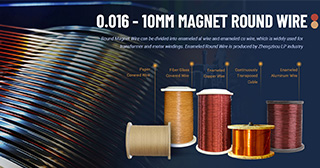
I. Definition and Basic Structure of Coil Winding Wire
Coil winding wire is a composite wire consisting of a conductor and an insulation layer.
Conductor: Responsible for conducting current, typically made of electrical copper or electrical aluminum, requiring high conductivity, good flexibility, and stable mechanical properties.
Insulation Layer: Forms electrical insulation on the conductor surface to prevent short circuits between adjacent turns. The insulation layer can be an insulating varnish (enameled wire), an insulating film (film-covered wire), fiberglass, yarn, or a combination of these materials.
Working Principle: When current flows through the winding wire, a magnetic field is generated around the conductor. This magnetic field can be used for energy conversion (such as electromagnetic torque in a motor), voltage transformation (such as electromagnetic induction in a transformer), or energy storage (such as magnetic energy storage in an inductor).
II. Conductor Materials
2.1 Copper Conductor
Copper is the most commonly used conductor material for coil winding wire:
- Conductivity: ≥97% IACS (100% IACS is the theoretical value)
- Advantages: High conductivity, high strength, good weldability, corrosion resistance
- Disadvantages: Higher cost, heavier weight (density 8.96 g/cm³)
2.2 Aluminum Conductor
Aluminum conductors are widely used in cost-sensitive and lightweight applications:
- Conductivity: ≥61% IACS
- Advantages: Low cost, lightweight (density 2.70 g/cm³, approximately 30% of copper)
- Disadvantages: Requires a larger cross-sectional area to achieve the same conductivity as copper, more demanding splicing processes
2.3 Copper-Clad Aluminum Conductor
Copper-clad aluminum conductor combines the advantages of copper and aluminum:
- Structure: Aluminum core with an outer copper layer
- Advantages: Higher conductivity than pure aluminum, lighter weight than pure copper, lower cost than pure copper
- Disadvantages: Special splicing process
III. Insulation System
3.1 Enameled Wire
Enameled wire is the most commonly used type of coil winding wire. The insulation layer is an organic insulating varnish:
- Polyurethane (UEW): Class 130/155, can be directly soldered, suitable for small coils
- Polyester (PEW): Class 130/155, good overall performance, suitable for general motors and transformers
- Polyester-imide (PEIW/EIW): Class 155, better heat and chemical resistance
- Polyester-imide/Polyamide-imide (EI/AIW): Class 180/200, high temperature resistance, suitable for variable frequency motors and new energy vehicle drive motors
- Polyamide-imide (AIW): Class 200, highest thermal class
3.2 Film Covered Wire
One or more layers of insulating film (such as polyester film, polyimide film) are wrapped around the conductor surface:
- Polyester film (Mylar): Class 130/155
- Polyimide film (Kapton): Class 220
- Suitable for applications requiring higher insulation strength
3.3 Fiberglass Covered Wire
Glass fiber is wrapped around the conductor surface and impregnated with resin:
- Class 180 (H class) and above
- Suitable for high temperature, high voltage, and large cross-section applications
3.4 Fabric Covered Wire
Cotton yarn, silk, or synthetic fiber is wrapped around the conductor surface:
- Suitable for low voltage and small electronic equipment
3.5 Composite Insulated Wire
A combination of multiple insulation materials is used, such as enameled + film covering (Class E/F or Class H composite insulation):
- Combines the advantages of multiple insulation materials
- Suitable for special operating conditions
IV. Classification of Coil Winding Wires
4.1 Classification by Conductor Material
- Enameled copper wire
- Enameled aluminum wire
- Copper-clad aluminum wire
4.2 Classification by Cross-Sectional Shape
- Round Wire: The most common form, suitable for most applications
- Flat Wire: Rectangular cross-section, high slot fill factor, suitable for new energy vehicle drive motors, high-power motors, and high-capacity transformers
4.3 Classification by Insulation Class
| Insulation Class | Maximum Operating Temperature | Typical Insulation Material |
|---|---|---|
| Class A | 105°C | Impregnated cotton yarn, silk |
| Class E | 120°C | Polyester enameled wire |
| Class B | 130°C | Polyester enameled wire |
| Class F | 155°C | Polyester-imide enameled wire |
| Class H | 180°C | Polyamide-imide, fiberglass |
| Class C | 220°C+ | Polyimide film, mica |
V. Main Application Scenarios
5.1 Motor Coils
The application of coil winding wire in motors is the most widespread:
- Household Appliance Motors: Fan motors, washing machine motors, compressor motors
- Industrial Motors: AC motors, DC motors, servo motors
- New Energy Vehicle Drive Motors: Flat wire windings, Class 180/200
- Stepper Motors: Precision control applications
5.2 Transformer Coils
- Power Distribution Transformers: Copper or aluminum wire windings
- Dry-Type Transformers: Class F/H insulation
- Oil-Immersed Transformers: Class A/B insulation
- Special Transformers: Electric furnace transformers, rectifier transformers
5.3 Inductor Coils
- Power Inductors: Energy storage, filtering
- Electronic Inductors: Communication, consumer electronics
- Common Mode Inductors: EMI filtering
5.4 Other Applications
- Relays: Coil winding
- Ballasts: Fluorescent lamp, HID lamp ballasts
- Electromagnets: Industrial, medical equipment
- Solenoid Valves: Automation control
VI. Selection Guide
6.1 Conductor Selection
- Copper Wire: High performance requirements, space constraints, high-frequency applications
- Aluminum Wire: Cost-sensitive, lightweight requirements, large cross-section applications
- Copper-Clad Aluminum: Medium performance, cost and weight balance
6.2 Insulation Class Selection
Based on operating temperature and environmental conditions:
- Class 130/155: General industrial applications
- Class 180/200: High-temperature applications, variable frequency motors, new energy vehicles
- Class 200+: Extreme high-temperature applications
6.3 Cross-Section Shape Selection
- Round Wire: General applications, cost-effective
- Flat Wire: High slot fill factor, high power density, high heat dissipation requirements
6.4 Specifications Confirmation
- Wire diameter or cross-sectional dimensions
- Minimum breakdown voltage
- Flexibility requirements
- Certification requirements (UL, IEC, NEMA, etc.)
Conclusion
Coil winding wire is a core material in electrical equipment such as motors, transformers, and inductors. Understanding conductor materials, insulation systems, classification methods, and selection principles is fundamental for rational design and procurement.
Selecting the right coil winding wire requires comprehensive consideration of electrical performance, thermal performance, mechanical performance, cost, and application environment. Partnering with a professional manufacturer ensures access to high-quality winding wire products that meet application requirements.