

The Role of Enameled Copper Wire in Wind Turbine Generators
Wind turbine generators are engineering marvels that convert kinetic energy from wind into electrical power. At the heart of these machines lies the generator—a device that relies heavily on enameled copper wire for its electromagnetic functions. As wind energy continues its rapid growth trajectory, optimizing generator design through strategic wire selection becomes increasingly important for manufacturers seeking competitive advantages.
Understanding Wind Turbine Generator Requirements
Wind turbine generators face unique operating challenges that differ significantly from conventional industrial motors and transformers. These machines must withstand decades of operation while maintaining efficiency across wildly varying conditions. The electromagnetic components inside—stator windings, rotor windings, and excitation coils—all depend on high-quality enameled copper wire to deliver reliable performance.
Operating Environment Challenges
Wind turbine generators operate in demanding environments. Coastal installations face salt air corrosion. Desert locations deal with sand infiltration and extreme temperature swings. Offshore platforms endure relentless moisture and salt spray. These conditions stress every component, including the critical insulation systems protecting copper conductors.
Temperatures inside generators fluctuate dramatically during operation. When wind speeds drop, turbines reduce output and components cool. When winds pick up, generators ramp up to full power and internal temperatures rise. This thermal cycling—repeated heating and cooling—tests the integrity of wire insulation over thousands of operating cycles.
Key Wire Specifications for Wind Generator Applications
Thermal Class Requirements
Wind turbine generators typically require enameled copper wire rated at Class F (155°C) or Class H (180°C) thermal performance. This classification indicates the maximum sustained operating temperature the insulation can handle without accelerated aging. Generators designed for offshore or tropical installations often specify Class H to provide additional thermal margin for high ambient temperatures and reduced cooling efficiency.
The thermal class requirement stems from generator efficiency considerations. Higher efficiency designs generate less waste heat, but even optimized machines produce significant thermal stress during maximum power operation. Wire thermal ratings must exceed expected operating temperatures by adequate margins to ensure 20-25 year service life.
Electrical Performance Needs
Modern wind turbines operate at voltages ranging from 690V to 3,000V depending on generator size and configuration. The enameled wire insulation must withstand these voltage levels while maintaining reliable dielectric properties despite thermal cycling, moisture exposure, and mechanical vibration. Breakdown voltage ratings exceeding 8kV provide appropriate safety margins for most wind generator applications.
Mechanical Properties
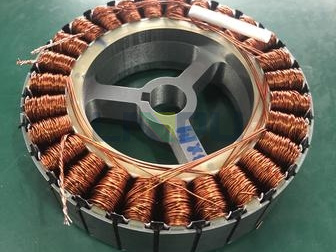
During manufacturing, stator and rotor windings undergo significant mechanical stress. Wires must flex without cracking during coil winding, maintain position during insertion into laminations, and withstand electromagnetic forces during operation. Key mechanical requirements include:
- Elongation exceeding 30% to withstand winding stress
- Strong adhesion between insulation and conductor
- Resistance to abrasion during handling and insertion
- Low springiness to maintain coil geometry after winding
Generator Types and Wire Selection
Induction Generators
Induction generators—commonly used in older or smaller wind turbines—employ squirrel cage or wound rotor designs. These machines use enameled wire in stator windings operating at frequencies matching grid connection (typically 50Hz or 60Hz). Wire selection focuses on thermal performance and cost-effectiveness since induction generators operate at moderate efficiency levels where extreme wire specifications aren’t always justified.
Permanent Magnet Synchronous Generators (PMSG)
Modern offshore and high-capacity wind turbines predominantly use PMSG designs. These generators achieve superior efficiency by eliminating rotor field excitation losses. The permanent magnets provide constant flux, allowing the stator to operate at variable frequencies converted to grid-compatible output through power electronics.
PMSG designs require high-quality enameled wire in their stator windings, with emphasis on:
- Low AC resistance at variable frequencies (skin and proximity effects)
- Superior insulation for high-voltage operation
- Excellent thermal conductivity for heat dissipation
- Outstanding flexibility for complex winding patterns
Double-Fed Induction Generators (DFIG)
DFIG configurations appear in many mid-size commercial wind turbines. These machines feature wound rotors with slip ring connections, allowing variable-speed operation through rotor circuit control. The rotor windings use heavier gauge enameled copper wire rated for Class F or Class H thermal performance, while stator windings resemble conventional induction generator construction.
Optimizing Generator Design Through Wire Selection
Slot Fill Optimization
The physical space available for windings in generator slots directly impacts machine efficiency and size. Higher slot fill—more copper area relative to total slot area—reduces stator current density and associated resistive losses. Premium wire products with tight dimensional tolerances and consistent insulation thickness enable higher fill factors, improving efficiency without increasing generator size.
Loss Reduction Strategies
Generator losses fall into several categories: copper losses (I²R), iron losses in the magnetic core, mechanical losses from friction and ventilation, and stray load losses. Strategic wire selection primarily affects copper losses, which often dominate at rated load conditions. Using larger conductor cross-sections where feasible reduces resistance and associated heating, though practical constraints on slot size and wire manufacturing limit this approach.
Thermal Management
Heat management represents one of the most critical aspects of wind generator design. The insulation system’s thermal limit constrains how much power a generator can produce continuously. Wire products with higher thermal ratings allow increased power density or improved efficiency margins. Some manufacturers use specialized high thermal conductivity enamels that enhance heat transfer away from copper conductors, though these products command premium pricing.
Quality Considerations for Wind Energy Applications
Testing and Certification Requirements
Wind turbine generators require components capable of performing reliably for 20-25 years with minimal maintenance. This demanding lifespan necessitates thorough qualification testing for enameled wire products. Key certifications and tests include:
- IEC 60317 standards for dimensional and performance specifications
- UL certification for electrical safety compliance
- Thermal life testing per IEC 60172 or similar procedures
- Vibration resistance testing for mechanical robustness
- Humidity and salt spray exposure for harsh environment capability
Supplier Qualification
Establishing supply relationships with qualified manufacturers proves essential for wind generator production. Key evaluation criteria include manufacturing consistency (test results should show minimal batch-to-batch variation), production capacity matching your requirements, technical support capability for specification questions, and logistics reliability for just-in-time delivery needs.
Cost Considerations and Value Analysis
While high-performance enameled copper wire commands premium pricing, the total cost impact on generator manufacturing remains relatively modest compared to other raw materials like permanent magnets, steel laminations, and bearings. The incremental cost of upgrading wire specifications often proves justified by improved generator efficiency, extended service life, and reduced warranty claims.
Generators designed for offshore wind installations face particularly stringent requirements given the extreme difficulty and expense of maintenance operations at sea. Using premium wire products in these machines reduces failure risks that could require costly offshore service vessels and extended turbine downtime.
Sourcing Strategy for Wind Generator Manufacturers
Direct Factory Relationships
Establishing direct relationships with enameled copper wire manufacturers offers significant advantages for wind generator producers. Direct purchasing typically provides 15-25% cost savings compared to distributor channels, access to technical expertise for specification optimization, priority allocation during tight supply conditions, and customization capabilities for unique application requirements.
Specification Alignment
Work with wire manufacturers to align specifications with actual generator requirements rather than over-specifying. Using Class H wire in an application that only reaches Class B temperatures represents unnecessary cost. Conversely, under-specifying wire for demanding applications leads to premature failures. Balance performance margins against cost considerations for optimal value.
Future Trends in Wind Generator Wire Technology
The wind energy industry continues evolving toward larger, more efficient machines. Next-generation turbines exceeding 15MW capacity will push generator design boundaries, requiring corresponding advances in wire technology. Areas of development include improved thermal conductivity enamels, enhanced fatigue resistance for extreme operating conditions, and manufacturing processes enabling higher slot fill factors.
Recycling and sustainability concerns are also gaining attention. Wire manufacturers increasingly offer products with documented environmental compliance, supporting wind energy’s position as a green power source throughout its lifecycle.
Contact Our Technical Team
LP Industry supplies premium enameled copper wire to wind turbine generator manufacturers worldwide. Our product range covers all common specifications for wind energy applications, from standard Class F products to specialized high-performance wires for demanding offshore installations. We welcome technical discussions about your generator designs and wire requirements.