

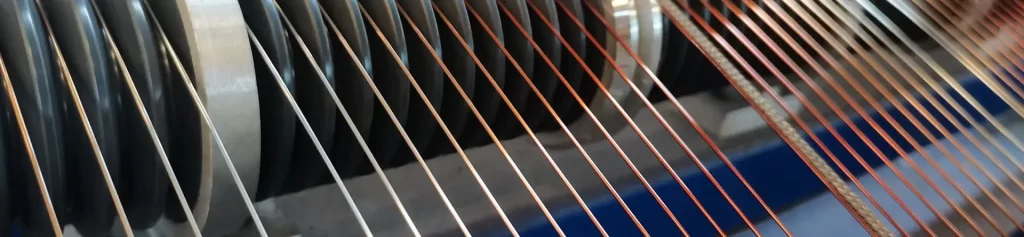
Copper clad aluminum enameled wire (CCA enameled wire) has emerged as an important innovative material in the electromagnetic wire industry, gaining increasingly widespread application in motor, transformer, and electronic equipment manufacturing in recent years. This composite material combines the excellent conductivity of copper with the lightweight advantages of aluminum, providing engineers and manufacturers with a new solution that balances performance and cost.
However, can copper clad aluminum enameled wire truly replace traditional pure copper enameled wire? What are the respective advantages and limitations of the two materials in different application scenarios? This article provides a systematic and objective comparative analysis guide for engineering technicians and procurement decision-makers from six dimensions: material structure, electrical performance, mechanical performance, thermal performance, cost analysis, and application scenarios.
I. Material Structure and Manufacturing Process
1.1 Structure of Copper Clad Aluminum Enameled Wire
Copper clad aluminum enameled wire is a bimetallic composite material, consisting of an aluminum core as the inner layer and a copper cladding layer as the outer layer. In typical copper clad aluminum wire, the copper layer accounts for approximately 15% by volume, while the aluminum core accounts for approximately 85%. The copper layer and aluminum core are metallurgically bonded to form a strong interface, ensuring that delamination does not occur during subsequent processing and use.
There are two main manufacturing processes for copper clad aluminum wire:
Clad Welding Method: Copper strip is wrapped around the exterior of an aluminum rod, forming a metallurgical bond through continuous extrusion and welding. This method has high production efficiency and good interface bonding quality, making it the current mainstream manufacturing process.
Co-extrusion Method: Copper and aluminum are simultaneously heated and extruded into shape. This method is suitable for large-diameter wire but requires significant equipment investment.
After manufacturing, the copper clad aluminum conductor undergoes wire drawing, annealing, and coating processes to ultimately form copper clad aluminum enameled wire.
1.2 Structure of Traditional Pure Copper Enameled Wire
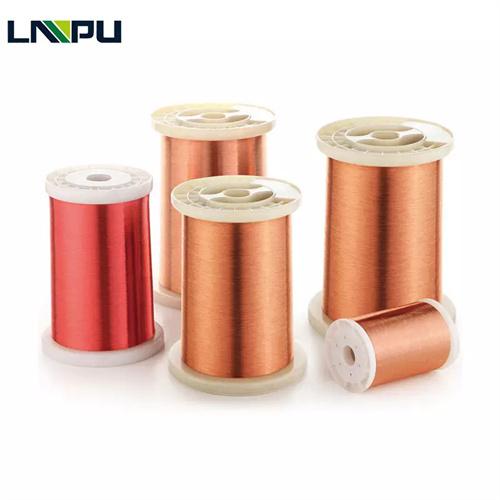
Traditional pure copper enameled wire uses electrolytic copper (purity ≥99.9%) as the conductor, which undergoes wire drawing, annealing, and then coating with an insulating enamel film. Pure copper enameled wire is the most mature and widely used product in the electromagnetic wire industry, with conductivity reaching 100% IACS, and mechanical and thermal performance already at optimal levels.
II. Electrical Performance Comparison
2.1 DC Resistance
Conductivity is the core indicator for measuring a wire’s electrical conducting capability. Pure copper has a conductivity of 100% IACS, while copper clad aluminum wire typically has a conductivity of 61-65% IACS (depending on copper layer thickness and aluminum core purity). This means that, at the same cross-sectional area, the DC resistance of copper clad aluminum wire is approximately 55-60% higher than that of pure copper wire.
To achieve the same DC resistance level as pure copper wire, the cross-sectional area of copper clad aluminum wire needs to be increased by approximately 1.6 times, and the wire diameter by approximately 1.26 times. In motor or transformer winding design, this dimensional change needs to be considered in slot fill rate and winding space design.
2.2 AC Resistance and Skin Effect
In high-frequency applications, the skin effect causes current to concentrate on the surface of the conductor. Since copper clad aluminum wire has a copper surface layer, at high frequencies, current primarily flows through the copper layer, resulting in AC resistance close to that of pure copper wire of the same diameter.
This characteristic gives copper clad aluminum enameled wire a unique advantage in applications such as high-frequency transformers, high-frequency inductors, and switching power supply transformers. When the operating frequency exceeds 10kHz, the AC resistance advantage of copper clad aluminum wire begins to emerge; when the frequency reaches above 100kHz, the difference in AC resistance between copper clad aluminum wire and pure copper wire is already very small.
| Performance Indicator | CCA Enameled Wire | Pure Copper Enameled Wire | Difference Description |
|---|---|---|---|
| Conductivity | 61-65% IACS | 100% IACS | CCA approximately 35-39% lower |
| DC Resistance (same cross-section) | 55-60% higher | Baseline | Requires increased cross-section for compensation |
| AC Resistance (high frequency) | Close to pure copper | Baseline | Small difference under skin effect |
| Density | 3.63 g/cm³ | 8.96 g/cm³ | CCA approximately 59% lighter |
III. Mechanical Performance Comparison
3.1 Tensile Strength
The tensile strength of pure copper enameled wire is typically 200-300 MPa (hard state) or 150-250 MPa (soft state), while the tensile strength of copper clad aluminum enameled wire is typically 150-250 MPa. The tensile strength of copper clad aluminum wire is slightly lower than that of pure copper wire, but in most motor and transformer winding applications, this strength level is fully adequate.
3.2 Flexibility and Bending Performance
The flexibility of copper clad aluminum enameled wire is comparable to that of pure copper enameled wire, with no wire breakage or enamel film damage during normal winding processes. Due to the presence of the aluminum core, copper clad aluminum wire has slightly greater springback after bending compared to pure copper wire, requiring appropriate adjustments to tension control parameters in the winding process.
3.3 Connection Performance
Multiple connection methods are available for copper clad aluminum enameled wire:
- Ultrasonic Welding: The most reliable connection method, suitable for automated production lines, with low and stable joint resistance.
- Thermal Welding: Utilizes the metallurgical bonding characteristics of the copper layer and aluminum core at high temperatures, suitable for medium-diameter wire.
- Mechanical Crimping: Suitable for large-diameter wire, requiring dedicated copper-aluminum transition terminals.
It is worth noting that the connection process for copper clad aluminum wire differs from that of pure aluminum wire. Due to the copper surface layer, the welding performance is closer to that of copper wire, and the connection difficulty is lower than that of pure aluminum wire.
IV. Thermal Performance Comparison
4.1 Thermal Class
The thermal class of copper clad aluminum enameled wire depends on the type of insulating enamel film applied. Similar to pure copper enameled wire, products with different thermal classes such as Class B (130°C), Class F (155°C), and Class H (180°C) are available. Under the same insulation system, the thermal performance of the two conductor types is essentially consistent.
4.2 Thermal Conductivity
Copper has a thermal conductivity of 401 W/(m·K), while aluminum has a thermal conductivity of 237 W/(m·K). The overall thermal conductivity of copper clad aluminum wire falls between the two, approximately 60-70% of pure copper. In motor or transformer windings, the thermal conductivity of the conductor has a limited impact on overall heat dissipation, as heat is primarily conducted through the insulating enamel film, slot insulation materials, and housing.
Practical tests have shown that in reasonably designed motors, the steady-state temperature rise difference between copper clad aluminum windings and pure copper windings is typically within 3-8°C. This gap can be further narrowed through appropriate heat dissipation design optimization.
4.3 Thermal Expansion Coefficient
Copper and aluminum have different thermal expansion coefficients (copper: 16.5×10⁻⁶/°C, aluminum: 23.1×10⁻⁶/°C). During temperature cycling, thermal stress may develop between the copper layer and aluminum core of copper clad aluminum wire. However, due to the sufficient strength of the metallurgical bonding interface, delamination does not occur under normal usage conditions.
V. Cost Analysis
5.1 Raw Material Cost
The raw material cost of copper clad aluminum enameled wire is significantly lower than that of pure copper enameled wire. Using 2024 market prices as an example, electrolytic copper prices are approximately $8,000-9,000 per ton, while electrolytic aluminum prices are approximately $2,500-3,000 per ton. Considering that the copper layer in copper clad aluminum wire accounts for only 15% by volume, its raw material cost is approximately 20-30% lower than that of pure copper wire.
5.2 Comprehensive Manufacturing Cost
In addition to raw material costs, copper clad aluminum enameled wire offers the following cost advantages:
- Transportation Cost: Copper clad aluminum wire has a density of only 40% that of pure copper, with weight approximately 60% lighter for the same length, significantly reducing logistics expenses.
- Processing Efficiency: Copper clad aluminum wire is lighter, resulting in lower inertia during the winding process, which is conducive to increasing winding speed and production efficiency.
- Inventory Cost: Copper clad aluminum wire of the same weight is 2.5 times longer than pure copper wire, reducing inventory space requirements.
5.3 Full Life Cycle Cost
From a full life cycle cost perspective, copper clad aluminum enameled wire has a clear advantage in initial procurement cost, with operating energy consumption costs essentially equivalent to pure copper wire (under reasonable design conditions), and no significant difference in maintenance costs. Overall, copper clad aluminum enameled wire offers better economic viability in most industrial and home appliance application scenarios.
VI. Application Scenario Analysis
6.1 Advantageous Application Scenarios for CCA Enameled Wire
- High-Frequency Transformers: In switching power supply transformers, high-frequency inductors, and other applications, copper clad aluminum enameled wire utilizes the skin effect to achieve AC resistance close to pure copper at high frequencies, while offering lower cost and lighter weight.
- Relays and Contactors: Relay and contactor coils are sensitive to wire weight, and copper clad aluminum enameled wire can significantly reduce product weight while meeting electrical performance requirements.
- Micro Motors: Micro motor winding space is limited, and copper clad aluminum enameled wire can achieve the same performance as pure copper wire with appropriately increased wire diameter, at lower cost.
- Ballasts: Inductor coils in fluorescent lamp ballasts and LED driver power supplies widely use copper clad aluminum enameled wire, taking advantage of its cost benefits and high-frequency performance.
6.2 Advantageous Application Scenarios for Pure Copper Enameled Wire
- High-Power Motors: High-power motors have strict requirements for efficiency and temperature rise, and the low resistance characteristics of pure copper enameled wire help reduce copper losses and improve efficiency.
- High-Reliability Applications: In high-reliability application fields such as aerospace and military, the maturity and reliability of pure copper enameled wire have been long-validated as the preferred choice.
- High-Current Applications: In high-current application scenarios, the low resistance characteristics of pure copper enameled wire can reduce heating and improve system safety.
VII. Selection Recommendations
When choosing between copper clad aluminum enameled wire and pure copper enameled wire, it is recommended to evaluate from the following dimensions:
- Operating Frequency: For high-frequency applications (>10kHz), copper clad aluminum enameled wire is preferred; for low-frequency applications (50/60Hz), the impact of increased cross-section on slot fill rate needs to be assessed.
- Cost Sensitivity: In cost-sensitive application scenarios, copper clad aluminum enameled wire can save 20-30% in material costs.
- Weight Requirements: For weight-sensitive applications (such as portable devices, automotive electronics), copper clad aluminum enameled wire can reduce weight by 50-60%.
- Space Constraints: In applications with sufficient winding space, copper clad aluminum enameled wire can compensate for conductivity differences by increasing wire diameter; space-constrained applications require careful evaluation.
- Reliability Requirements: For high-reliability applications, pure copper enameled wire is recommended; for general industrial and home appliance applications, copper clad aluminum enameled wire is fully adequate.
Conclusion
Copper clad aluminum enameled wire and traditional pure copper enameled wire each have their unique advantages and applicable scenarios. Copper clad aluminum enameled wire, with its lightweight, cost advantages, and high-frequency performance, demonstrates strong competitiveness in applications such as high-frequency transformers, relays, and micro motors. Meanwhile, pure copper enameled wire maintains an irreplaceable position in low-resistance, high-reliability, and high-power applications.
Engineering technicians and procurement decision-makers should scientifically and reasonably select wire materials based on specific application requirements, cost budgets, and performance requirements. Using copper clad aluminum enameled wire in appropriate scenarios can achieve significant cost reduction and efficiency improvement while ensuring product quality.