

Chapter 1 Product Overview and Market Positioning
1.1 Product Definition and Core Technical Parameters 14 AWG enameled copper wire (American Wire Gauge 14) is one of the most core basic materials in the global wire market.
According to the internationally accepted AWG wire gauge standard, 14 AWG corresponds to a nominal diameter of 1.628 mm, a conductor cross-sectional area of 2.08 mm², and a DC resistance of approximately 8.28 Ω/km under standard conditions at 20°C.
This product corresponds to the relevant provisions of GB/T 6109.1 in the national standard system of the People’s Republic of China and is one of the most widely used specifications in the manufacturing of motors, transformers, and power electronic equipment.
In terms of material composition, 14 AWG enameled copper wire uses high-purity electrolytic copper as the conductor substrate, coated with one or more layers of heat-resistant insulating enamel coating.
The insulating enamel coating is not an ordinary organic coating, but a specialized insulating medium based on high-performance polymer materials such as polyesterimide (PEI), polyamide-imide (PAI), and polyurethane (PU).
Through multiple coating and baking curing processes, the insulating enamel coating forms a chemical bond with the copper substrate, ensuring excellent electrical performance without negatively impacting the conductor’s conductivity.
From a physical parameter perspective, 14 AWG specifications occupy a special market position in the industrial electrical wire product system.
On the one hand, this wire diameter meets the basic requirements for winding wire diameter in small and medium-sized motors with power ranges from 0.75kW to 15kW; on the other hand, its wire diameter specifications combine good flexibility and cost-effectiveness—the wire diameter is neither too thin, which would increase the risk of breakage during winding, nor too thick, which would affect slot fill factor and the flexibility of motor design.
Therefore, 14 AWG enameled copper wire has long held a leading position in global electrical wire trade in terms of demand.
The term “enameled” accurately describes the core characteristic of this product—an insulating organic coating on the surface of the copper conductor.
The thickness, uniformity, adhesion, and thermal class of this coating directly determine the electrical performance, mechanical strength, and service life of the enameled wire product.
1.2 Market Application Scenarios Analysis The downstream applications of 14 AWG enameled copper wire are extremely broad, covering almost all industrial scenarios requiring electromagnetic induction principles.
From an industry perspective, the main application areas of this product include the following: In the field of electrical engineering, 14 AWG enameled copper wire is mainly used to manufacture various small and medium-sized industrial motors, motors for household appliances, drive motors for power tools, servo system motors, and water pump motors, etc.
Taking the common Y-series three-phase asynchronous motor as an example, motor windings in the 0.75kW to 15kW power range generally use 14 AWG enameled copper wire as the main winding material.
In the transformer manufacturing field, 14 AWG enameled copper wire is widely used in the production of power conversion devices such as high-frequency switching power supply transformers, power distribution transformer windings, and charger isolation transformers.
With the rapid development of power electronics technology, the operating frequency of switching power supplies is constantly increasing (50kHz to 500kHz or even higher), placing higher demands on the high-frequency performance of enameled wire.
In recent years, with the global energy structure transformation and the booming development of the new energy industry, the usage of 14 AWG enameled copper wire in emerging application areas has increased significantly.
Emerging fields such as photovoltaic inverters, new energy vehicle charging stations, and DC-DC conversion devices for energy storage systems have placed more stringent technical requirements on the thermal class and insulation reliability of enameled wire, driving the technological upgrading and market expansion of high-end enameled wire products.
In terms of global market size, the annual international trade volume of 14 AWG enameled copper wire is approximately 1.2 million tons, of which the Asian market accounts for about 65% (mainland China is the largest producer and exporter), the North American market about 18%, and the European market about 12%.
As the world’s largest producer and exporter of electrical wire, China exports approximately 350,000 tons of electrical wire products to overseas markets annually, with 14 AWG specifications accounting for a significant share.
1.3 Industry Development Background and Technological Evolution Trends The market development of the electrical wire industry is closely related to the high prosperity of downstream industries such as motors, transformers, and power electronics.
Over the past decade, the global motor industry has maintained an average annual growth rate of approximately 3.5%, driving a steady increase in demand for electrical wire.
Of particular note is the significantly higher growth rate of demand for high-performance electrical wire from strategic emerging industries such as new energy vehicles, wind power generation, and photovoltaic energy storage compared to traditional industries.
From a technological evolution perspective, the current electrical wire industry is developing in the following directions: First, thermal class is continuously increasing.
Traditional 130°C and 155°C grade products are evolving towards 180°C, 200°C, and even 240°C grades.
This trend is primarily driven by high-end applications such as new energy vehicle drive motors—drive motors operate at high temperatures and have complex heat dissipation conditions, placing extremely stringent requirements on the heat resistance of enameled wires.
Secondly, increasingly stringent environmental requirements.
The EU RoHS Directive (2011/65/EU) and REACH Regulation (1907/2006/EC) have clearly limited the content of hazardous substances in electrical and electronic equipment, leading to a continuous upgrade in insulating varnish formulations towards environmentally friendly and water-based methods.
Thirdly, the demand for energy conservation and emission reduction is driving product structure adjustments.
Large-section flat wires (rectangular wires) have seen rapid adoption in the new energy drive motor field due to their ability to effectively improve slot fill factor and motor power density, but traditional round wire products still dominate in low- to mid-range applications.
Fourthly, the deep penetration of intelligent manufacturing technologies.
The increasing prevalence of technologies such as automated online inspection, intelligent warehousing and logistics, and digital production line management is driving continuous improvement in the quality stability and production efficiency of enameled wire products.
Chapter 2 Technical Specifications and Standards System
2.1 Detailed Explanation of Conductor Materials and Specifications Parameters 14 AWG enameled copper wire uses 99.99% high-purity oxygen-free copper (OFC).
Oxygen-free copper has a copper content of no less than 99.99% and an oxygen content controlled below 10 ppm.
This material characteristic gives it the following significant advantages: Higher conductivity—Oxygen-free copper can achieve a conductivity of over 101.5% IACS, significantly better than ordinary electrolytic copper; Stable temperature coefficient of resistance—Ensuring controllable resistance changes at different operating temperatures; Excellent ductility and flexibility—Suitable for high-speed automated winding operations; Superior high temperature resistance—Not easily oxidized or deteriorated in high-temperature operating environments.
From a physical specifications perspective, the main technical parameters of 14 AWG enameled copper wire are as follows: Nominal diameter: 1.628mm (AWG standard specifies tolerance range ±0.008mm) Conductor cross-sectional area: 2.08mm² DC resistance: ≤8.28Ω/km (at 20°C) Conductor tolerance: ±0.008mm (some manufacturers can control it within ±0.005mm) Elongation: ≥30% (elongation after fracture) Tensile strength: ≥200N/mm² In the conductor processing stage, manufacturers using advanced high-speed wire drawing technology can control the copper wire diameter tolerance within ±0.005mm and the surface finish Ra≤0.8μm, effectively ensuring the uniformity and adhesion strength of subsequent enameled coating.
2.2 Insulation Class and Heat Resistance Insulation class is one of the core indicators for evaluating the performance of enameled wire products, directly determining the highest operating temperature that enameled wire can withstand during long-term operation without insulation failure.
According to international standards IEC 60317 and NEMA MW 1000, the thermal class of enameled wire is expressed as “thermal class,” which is the highest ambient temperature that enameled wire can withstand for a long period without irreversible degradation of insulation performance under normal operating conditions.
The common insulation classes and technical characteristics of AWG enameled copper wire are as follows: 155°C Class (UEW / polyester enameled wire) – Insulation material: polyester – Heat resistance temperature: 155°C – Softening breakdown temperature: ≥240°C – Chemical resistance: Good – Main applications: General industrial motors, general transformer windings, household appliance motors 180°C Class (PEW / polyester imide) – Insulation material: polyester imide – Heat resistance temperature: 180°C – Softening breakdown temperature: ≥260°C – Chemical resistance: Excellent – Main applications: High-power motors, high-temperature operating environments, power transformers 200°C Class (EIW / polyamide-imide) – Insulation material: polyamide-imide PAI (Pressure Intake) – Heat Resistance Temperature: 200°C – Softening Breakdown Temperature: ≥300°C – Chemical Resistance: Excellent – Main Applications: New energy vehicle (drive motor), aerospace motors, high-end industrial equipment.
When selecting a product, factors such as operating temperature, heat dissipation, reliability requirements, and cost budget must be comprehensively considered.
Generally, for ordinary industrial applications, 155°C or 180°C grade products are sufficient; for high-end applications such as new energy vehicle (drive motor), it is recommended to choose products with a 200°C or higher grade to ensure operational reliability under harsh conditions.
2.3 Industry Standards and Certification Systems Products are subject to strict standards systems globally, and different regional markets have their own requirements for product certification.
A deep understanding of these standards systems is crucial for buyers engaged in international trade. International Standards (IEC System) IEC 60317 is a standard for special winding wires developed by the International Electrotechnical Commission (IEC).
The main standards related to 14 AWG enameled copper wire include: – IEC 60317-3: Polyester enameled round copper wire – IEC 60317-8: Polyester imide enameled round copper wire – IEC 60317-13: Polyamide-imide enameled round copper wire.
This standard clearly specifies key indicators such as dimensional tolerances, insulation thickness, mechanical properties, electrical properties, and heat resistance of enameled wire, and is a product specification recognized by most countries and regions worldwide. American Standards (NEMA System) NEMA MW 1000 is an electrical wire standard developed by the National Electrical Manufacturers Association (NEMA).
In this standard system, 14 AWG enameled copper wire typically corresponds to MW 35C (155°C class) or MW 80C (180°C class) specifications.
NEMA standards have a wide influence in the US and North American markets. European Standards (EN System) The European standard EN 60317 series is essentially equivalent to the IEC standard, but adds the REACH regulation’s restrictions on chemical substances.
Enameled wire products entering the European market must ensure that their insulation materials are free of hazardous substances such as polybrominated biphenyls (PBBs) and polybrominated diphenyl ethers (PBDEs). UL Certification UL (Underwriters Laboratories) is the most authoritative product safety certification body in the United States, with extremely high recognition in the North American market.
Enameled wire products that have passed UL certification signify that their safety performance is authoritatively recognized.
The UL certification mark includes a file number and thermal class information. RoHS and REACH The RoHS Directive (2011/65/EU) and the REACH Regulation (1907/2006/EC) are EU environmental protection regulations for electrical and electronic equipment and chemical substances.
The RoHS Directive restricts the use of six hazardous substances: lead, cadmium, mercury, hexavalent chromium, polybrominated biphenyls (PBBBs), and polybrominated diphenyl ethers (PBDEs).
The REACH Regulation establishes a comprehensive regulatory framework for the registration, evaluation, authorization, and restriction of chemicals.
Chapter 3 Materials Science and Manufacturing Processes
3.1 Analysis of the Entire Conductor Manufacturing Process The quality of enameled wire begins to be established from the conductor production stage.
High-quality copper conductor is a necessary prerequisite for ensuring the overall performance of enameled wire.
The main processes in conductor manufacturing include: Raw Material Inspection After the electrolytic copper ingots arrive at the factory, a chemical composition analysis is first performed to ensure that the copper content is ≥99.99% and that the content of impurity elements (especially iron, sulfur, oxygen, etc.) is controlled below the specified limits.
For critical batches, a hydrogen embrittlement test is also required to ensure that the copper material does not contain harmful inclusions that cause brittleness. Wire Drawing Process After initial rolling, the copper ingots enter the continuous wire drawing process.
Advanced manufacturing enterprises employ multi-stage wire drawing technology, where copper wires are sequentially drawn through drawing dies with different specifications (13, 11, 9, 8, etc.) to gradually reduce the wire diameter from 8mm to 1.628mm (14 AWG).
During the drawing process, the copper wires undergo annealing to eliminate work hardening and restore flexibility.
The application of continuous wire drawing and annealing integrated machines significantly improves drawing efficiency and quality stability. Surface Cleaning The surface of the drawn copper wires may retain drawing lubricant or oxides.
A combination of online electrolytic cleaning and high-temperature annealing ensures a clean and bright copper wire surface, providing the best substrate for subsequent enamel coating adhesion.
Surface cleanliness is typically tested using visual inspection and contact angle measurement; a surface tension ≥32mN/m is required before proceeding to the coating process.
3.2 Insulating Varnish Formulation and Coating Process Insulating varnish is the core technology of enameled wire, and its formulation and coating process directly determine the final performance of the product. Classification of Insulating Varnish Systems Currently, the main insulating varnishes used in industrial applications are as follows: 1. Polyester Varnish: Based on polyethylene terephthalate (PET), it has good heat resistance and insulation performance, is cost-effective, and is the mainstream choice for 155°C grade insulating wire. 2. Polyesterimide Varnish: Introducing imide groups into the polyester base, increasing the thermal class to 180°C while maintaining good mechanical strength and chemical resistance, it is currently the most widely used insulating varnish for insulating wire.
3. Polyamide-imide (PAI) varnish: The best-performing insulating varnish for enameled wires, with thermal class up to 200-240°C.
It boasts excellent chemical resistance, abrasion resistance, and peel resistance, primarily used in high-end motors and aerospace applications. 4. Polyurethane varnish: Primarily composed of linear polymers, it has a low softening point and is typically used for 130°C grade products or solderable enameled wires, facilitating direct soldering after automated winding. Coating Process: Enameled wire coating is a multi-layered, progressively layered process, mainly including the following steps: 1. Pre-baking: Before entering the coating device, the copper wire is preheated (approximately 200-250°C) to remove surface moisture and improve enamel coating adhesion. 2. Coating: The copper wire passes through a precisely metered varnish tank, where the insulating varnish is evenly coated onto the conductor surface.
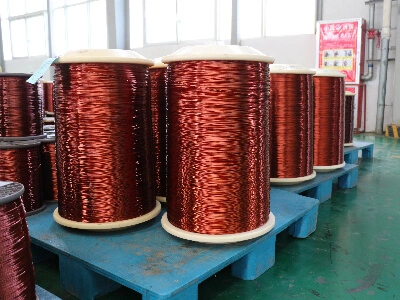
The amount of paint applied is precisely controlled by parameters such as the paint tank level, felt pressure, and paint mold aperture. 3. Baking: The coated enameled wire enters the baking channel and is baked at a high temperature of 300-400°C to cure it, causing the solvent in the insulating varnish to evaporate, the polymer chains to cross-link and solidify, forming a strong bond with the copper substrate. 4. Cooling: After baking, the enameled wire passes through a cooling section, where the temperature is gradually reduced to room temperature to avoid internal stress in the enameled coating due to sudden cooling. 5. Winding: The cooled enameled wire is wound onto a wooden spool using a tension control system.
The tension is typically controlled at 0.5-1.0 N/mm² to ensure the spools are neatly and tightly arranged.
The above coating-baking-cooling process usually needs to be repeated multiple times to achieve the specified insulation thickness.
Generally, a single layer of enameled coating is approximately 20-30 μm thick, and the total insulation thickness of 14 AWG enameled copper wire is typically 60-80 μm (one side).
For high-end applications, 6-8 coats or even more may be required.
3.3 Quality Control and Testing System Leading enameled wire manufacturers have established a comprehensive quality control system covering the entire process from raw material intake to finished product shipment.
Each production batch must pass the following key tests: Dimensional Inspection – Conductor Diameter: Continuous inspection with a laser diameter gauge, tolerance ±0.008mm – Insulation Thickness: Measurement with a micron-level thickness gauge, single-sided thickness 0.06-0.08mm – Enamelled Coating Uniformity: Ultrasonic non-destructive testing to detect the thickness dispersion of the enamel coating. Electrical Performance Inspection – Withstand Voltage Test: The enameled wire sample undergoes a dielectric test in water, standard 1500V/1s without breakdown (UEW) – Resistance Test: Four-wire precision resistance measurement, DC resistance ≤8.28Ω/km – Insulation Resistance: Measured with a high-resistance meter, insulation resistance value ≥100MΩ·km Mechanical Performance Inspection – Enamelled Coating Adhesion: Wire winding test to check for cracking or peeling of the enamel coating – Tensile Strength: Tested with a material testing machine, tensile strength ≥200N/mm² – Elongation: Elongation after fracture ≥30% Heat Resistance Inspection Softening breakdown test: Testing the softening temperature of the enamel coating under heating conditions – Thermal shock test: Rapid heating and cooling cycles to verify the thermal shock resistance of the enamel coating – Aging test: Testing electrical performance degradation after long-term aging at high temperatures
Chapter 4 In-depth analysis of application areas
4.1 Electrical Engineering Field Motors are the largest downstream application market for enameled wire.
The working principle of an electric motor is based on electromagnetic induction, where current generates a magnetic field in the windings to drive the rotor to rotate.
The enameled wire windings are the most crucial component of the motor; their conductor cross-section determines the motor’s power output capability, while insulation performance directly relates to the motor’s service life and reliability.
In the field of motors, typical applications of 14 AWG enameled copper wire include: Industrial motors: including Y-series three-phase asynchronous motors, variable frequency speed control motors, etc.
These motors typically operate in industrial production environments and have high requirements for reliability and durability. 14 AWG enameled copper wire can meet the winding needs of motors with power ranges from 0.75kW to 15kW. Household Appliance Motors: Motors for air conditioner compressors, refrigerator compressors, washing machine spin-drying motors, vacuum cleaner motors, etc.
These motors are produced in large batches, are cost-sensitive, and have stringent safety requirements. Power Tool Motors: Drive motors for handheld power tools such as electric drills, angle grinders, and chainsaws.
These motors typically operate under high speed and high load conditions, requiring high heat resistance and mechanical strength from the wire. Servo Motors: Servo motors commonly used in CNC machine tools and automated equipment, requiring high response speed, high precision, and high reliability. Water Pump Motors: Motors for various submersible pumps, centrifugal pumps, and sewage pumps.
These applications operate in humid environments, sometimes even requiring submersion in water, demanding excellent moisture resistance and reliability from the wire.
4.2 Transformers and Power Electronics Transformers are another major application area for wire.
The working principle of a transformer is also electromagnetic induction, achieving voltage transformation through the turns ratio between the primary and secondary windings. High-Frequency Switching Power Supply Transformer: This is one of the most widely used transformer types in the current power electronics field, extensively used in mobile phone chargers, laptop adapters, LED driver power supplies, communication equipment power supplies, etc.
Operating frequencies are typically in the range of 50kHz to 500kHz, requiring enameled wire with low skin effect losses and good high-frequency performance. Power Distribution Transformer: Power distribution transformers in power distribution systems, with power ranging from tens of kVA to thousands of kVA. Isolation Transformer: Transformers used for electrical isolation and safety protection, such as medical equipment isolation transformers and laboratory power supply isolation transformers. Inductors and Chokes: PFC inductors, filter inductors, energy storage inductors, etc., in power electronic circuits also typically require enameled wire winding.
4.3 New Energy and Emerging Applications With the global energy structure transformation and the booming development of the new energy industry, the demand for 14 AWG enameled copper wire in emerging fields is growing rapidly. New Energy Vehicle Drive Motors: New energy vehicle drive motors typically use permanent magnet synchronous motors or asynchronous motors, with power ranging from tens of kW to hundreds of kW.
These motors have high requirements for the thermal class of the wire (usually above 180°C). New Energy Vehicle Charging Stations: Power devices in charging stations (such as PFC inductors and DC-DC converters) require the use of wire windings. Photovoltaic Inverters: The core equipment of a photovoltaic power generation system, the inverter, contains magnetic components such as boost transformers, PFC inductors, and filter inductors. Energy Storage Systems: Power electronic devices such as DC-DC converters and inverters in energy storage power stations and home energy storage systems also require the use of magnetic components wound with wire.
Chapter 5 Selection Guide and Usage Recommendations
5.1 Four-Step Method for Scientific Selection Step 1: Determine the Insulation Class Determine the required thermal class based on the equipment’s operating temperature and environmental conditions.
The general principle is that the rated heat resistance temperature of the enameled wire should be at least 20% higher than the winding temperature during normal operation of the equipment, as a safety margin.
General industrial applications, ambient temperature ≤130°C: Select 155°C class (UEW) High-power equipment, ambient temperature ≤150°C: Select 180°C class (PEW) New energy vehicles, high-end equipment, ambient temperature ≤170°C: Select 200°C class (EIW) Step 2: Determine the Conductor Specifications Determine the conductor cross-sectional area based on the design current and current density requirements.
The cross-sectional area of 14 AWG enameled copper wire is 2.08 mm².
In conventional motor design, the current density is typically 3-5 A/mm², corresponding to a current carrying capacity of approximately 6-10 A. Step 3: Confirm Certification Requirements Based on the product’s target market and customer requirements, confirm the required certification standards: – North American market: UL certification required – European market: RoHS and REACH compliance required – General industrial use: IEC standard certification is sufficient – High-end applications: May require multiple certifications such as UL, IEC, and VDE Step 4: Evaluate Supplier Qualifications When selecting a supplier, it is recommended to focus on: whether they are a professional manufacturer, whether they have ISO9001 or other quality system certifications, whether they have UL/REACH or other certification certificates, whether they have export experience and overseas customer cases, whether their production capacity is stable, and whether they have technical support and after-sales service.
5.2 Precautions for Use Transportation and Storage – enameled wire should be stored in a dry, ventilated environment free from corrosive gases. – Avoid direct sunlight and rain. – Wooden shafts should be stacked horizontally to avoid deformation due to compression. – The recommended storage temperature is -10°C to 40°C, and the relative humidity is ≤70%. Winding Process – The winding tension should be moderate; too high a tension will damage the enamel coating, while too low a tension will result in loose wire. – The winding speed should match the enameled wire specifications. – The winding die should be smooth, without sharp corners or burrs. Welding and Impregnation – The varnish removal process should be carried out according to specifications to avoid high-temperature damage to adjacent enamel coating. – Before impregnating with insulating varnish, the solvent resistance of the enameled wire should be confirmed.
6.1 Product Specifications and Packaging Insulation Class: 155°C (UEW), 180°C (PEW), 200°C (EIW) Standard Packaging: – Wooden Shafts: Standard shaft diameter 305mm (12 inches), shaft width 250-300mm – Net Weight: 12-15kg/shaft (slightly varies depending on insulation class) – Outer Packaging: Carton or wooden crate Customization Services: – Carton packaging and wooden pallet packaging can be customized according to customer requirements – Small shaft diameter (e.g., 203mm) products are available, suitable for small batch shipments
6.2 Minimum Order Quantity and Delivery Time Minimum Order Quantity (MOQ): 300-500kg Sample Order: Small batches negotiable, delivery within 3-5 working days. Formal Order: Production according to schedule, delivery within 15-20 working days. Bulk Order (1 ton or more): Delivery within 20-30 working days, large batch prices negotiable.
6.3 Price Terms and Payment Methods Price Terms: EXW, FOB, CIF, DDP are all negotiable. Payment Methods: – T/T (Telegraphic Transfer): 30% prepayment, balance payable upon presentation of copy of bill of lading. – L/C (Letter of Credit): Letter of Credit at sight, negotiable.
6.4 Technical Support and After-Sales Service Our professional sales team provides: – Product selection consultation and technical parameter confirmation – Sample application and small batch trial order support – Answering process questions and handling quality feedback – Providing certification documents (UL certification, RoHS test report, etc.) – After-sales service response: Response within 24 hours.